The Complete Contractor SOP Library for Scaling Service Businesses

The contractor SOP library provides a framework for creating standardised processes to work with ServiceTitan.

Rather than depending on personal skills and information, home service companies grow by establishing processes to manage tasks like dispatching, customer service, field operations, accounting, and management.

In the absence of documented procedures, companies tend to face inconsistency in the delivery of their services, slow training for new employees, poor reporting, and risks.

Developing an SOP library can bring more consistency to your business and help you protect your income while laying the foundation for scaling up.

By using its Gold and Diamond memberships, Titan Pro Technologies develops an SOP library for HVAC, plumbing, electrical, roofing, and other home service companies with documentation in PDF and video format.

Quick Answer: What Is a Contractor SOP Library?

A contractor SOP library is a centralized collection of Standard Operating Procedures that documents how employees should perform important business processes consistently.

For a ServiceTitan-based home service company, an SOP library can cover dispatch and scheduling, customer service, technician field workflows, accounting, reporting, management, Pricebook usage, follow-ups, and other operational processes.

The purpose is to turn employee knowledge and informal processes into repeatable systems that can be taught, measured, updated, and used as the business grows.

In simple terms, a contractor SOP library tells your team how the business should operate, while ServiceTitan provides the technology used to execute and manage those processes.

This becomes increasingly important as a company adds technicians, employees, departments, territories, locations, services, and customers.

Why Businesses Without SOPs Struggle to Scale

This is because many contractors can run effectively through informal processes when they have small teams.

When businesses employ more technicians, offer services in new territories, and create new departments, informal processes can be difficult to manage.

Employees do not follow consistent process flows but create their own ways, leading to inconsistent customer experience, inaccurate reporting, and inefficient operations.

Some of the common scaling problems include:

  • Inconsistent customer experience: Each employee does things like answering phone calls and scheduling in their own way.
  • Slow onboarding process: New hires get onboarded through shadowing rather than documented process flows.
  • Gaps in operational knowledge: Operational knowledge stays with each employee rather than the business.
  • Inaccurate reporting: Inconsistent process flows lead to inaccurate ServiceTitan reporting and key performance indicators.
  • Different department processes: Teams develop separate ways of completing connected tasks.
  • Missed follow-ups: Employees may not have a consistent process for estimates, memberships, callbacks, or customer communication.
  • Inconsistent documentation: Technicians and office teams may record information differently.

SOPs transform operational knowledge into systems.

What Are the Signs That a Contractor Needs an SOP Library?

A contractor may need a formal SOP library when employees are performing the same task differently, managers repeatedly have to explain processes, or new employees depend heavily on shadowing and verbal instructions.

Other common signs include:

  • Different dispatchers following different scheduling rules.
  • CSRs using different call-handling processes.
  • Technicians documenting jobs differently.
  • Important customer follow-ups being missed.
  • Employees relying on spreadsheets or personal notes.
  • Managers repeatedly correcting the same operational mistakes.
  • New employees taking too long to become productive.
  • ServiceTitan reporting becoming unreliable.
  • Employees asking the same process questions repeatedly.
  • Business knowledge remaining with individual employees instead of being documented.

These signs indicate that the company may have the software needed to operate the business but does not yet have a standardized operating system around it.

Dispatch and Scheduling SOPs

Dispatching is among the most operational aspects that can be standardized.

SOPs of dispatching will help teams plan their work consistently, make full use of the technicians’ potential, and avoid any unnecessary delay.

Key SOPs for dispatching are:

  • Scheduling policies: Define rules regarding priority allocation between emergency calls, maintenance calls, and normal service requests.
  • Assignment policies: Develop clear policies regarding technician selection based on their qualifications, availability, location, and workload.
  • Routing procedures: Describe processes of territory planning and scheduling to minimise travel time.
  • Urgent calls handling: Define procedures for escalations of urgent calls, after-hours requests, and priority scheduling.
  • Schedule change procedures: Define how cancellations, reschedules, delays, and emergency additions should be handled.

By having all dispatchers perform the process according to the same SOP, businesses will enhance scheduling consistency and will make better use of their technicians’ potential.

What Should a Dispatch SOP Include?

A dispatch SOP should clearly define how a technician is selected, how jobs are prioritized, how schedules are managed, and how exceptions are handled.

It can document:

  • Technician availability.
  • Technician skills and qualifications.
  • Service territories.
  • Job priority.
  • Job duration.
  • Routing requirements.
  • Emergency calls.
  • Cancellations.
  • Rescheduling.
  • After-hours procedures.
  • Dispatcher escalation rules.

This gives dispatchers a repeatable process rather than requiring them to rely on personal judgment for every scheduling decision.

CSR and Customer Communication SOPs

Customer service representatives create customer experience from the first call until the job is finished and followed up.

Standardized CSR processes improve consistency while ensuring ServiceTitan captures accurate operational data.

Key SOP categories include:

  • Call handling scripts: Standardize greetings, qualification questions, and appointment booking conversations.
  • Job creation workflows: Define how CSRs select job types, assign tags, and capture marketing sources.
  • Cancellation procedures: Create consistent rescheduling processes while protecting revenue opportunities.
  • Follow-up processes: Document how estimates, memberships, and customer communications are managed.
  • Customer communication: Define when and how customers should receive updates throughout the service process.

Consistent CSR workflows improve customer experience while supporting cleaner reporting and more reliable business data.

Why Are CSR SOPs Important for ServiceTitan?

CSR SOPs help ensure that customer information, job types, tags, marketing sources, scheduling information, and follow-up activities are captured consistently.

Without standardized processes, two CSRs may create the same type of job differently, which can affect customer experience, reporting, operational decisions, and the quality of ServiceTitan data.

A clear CSR SOP gives employees a defined process for handling common customer situations while also explaining what to do when an exception occurs.

Technician Field SOPs

Technician SOPs establish clear expectations for completing work consistently in the field.

Rather than relying on individual habits, technicians follow documented workflows that improve quality, reporting, and customer communication.

Important technician SOPs include:

  • Job documentation standards: Define required notes, forms, and information captured within the ServiceTitan mobile app.
  • Photo requirements: Establish when technicians should collect equipment photos, job images, and supporting documentation.
  • Usage of Pricebook: Set expectations around picking the right items, giving choices, and not using miscellaneous codes.
  • Customer interactions: Standardize how technicians talk about recommendations, give repair choices, and get approvals.
  • Job completion: Define what information must be completed before a technician closes a job.
  • Estimate procedures: Establish how estimates and recommendations should be presented and documented.

Consistency in field processes leads to better data, fewer callbacks, and a more professional customer experience.

What Should a Technician SOP Cover?

A technician SOP should explain what the technician is expected to do before, during, and after a service call.

This can include:

  1. Reviewing job information before arrival.
  2. Following the required arrival and customer communication process.
  3. Documenting the work performed.
  4. Taking required photos.
  5. Using the appropriate ServiceTitan Pricebook items.
  6. Presenting repair or service options according to company standards.
  7. Recording customer approvals.
  8. Completing required forms and notes.
  9. Completing the job according to the defined closeout process.

The exact workflow should be customized to the contractor’s services and operational requirements.

Accounting and Back Office SOPs

Operational success depends on accurate financial processes behind every completed job.

Back-office SOPs connect field activity with reliable accounting and reporting.

Important accounting workflows include:

  • Invoicing: Define the process of creating, reviewing, approving, and completing invoices.
  • Payment processing: Set guidelines for payment collection, refunds, and other financial processes.
  • Job costing review: Set guidelines for reviewing labor, materials costs, and job profitability.
  • Reporting process: Outline which reports leaders review, the frequency of those reviews, and the process for making operational decisions.
  • Reconciliation: Define procedures for identifying and resolving financial discrepancies.

Having clear accounting SOPs ensures companies can stay financially accurate while also having a better understanding of their margins and overall performance.

Why Do Accounting SOPs Matter in a Service Business?

Field operations and accounting are connected.

If job information, payments, invoices, materials, or labor information are not entered consistently, management may have difficulty understanding job profitability and overall business performance.

Accounting SOPs create a repeatable process for moving completed field-service activity into accurate financial records and reports.

The Main Categories of Accounting SOP Every Scaling Business Needs

contractor_sop

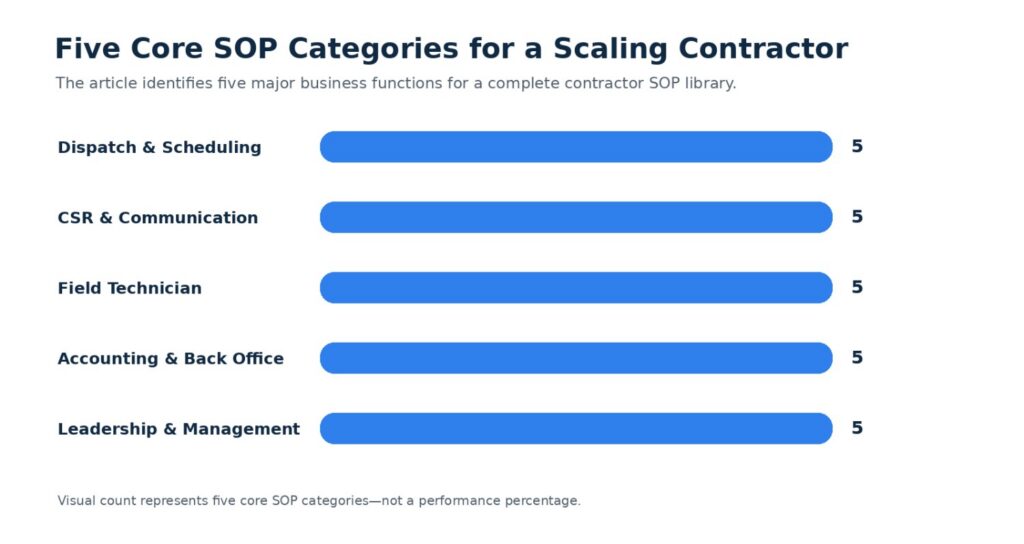
Each growing company needs to have documented SOPs for these five business functions:

  • Dispatch and Scheduling SOPs: Booking policies, technician scheduling, routing, and emergency response SOPs.
  • CSR and Communication SOPs: Call scripts, customer interactions, job scheduling, and follow-up procedures.
  • Field Technician SOPs: Documenting processes, Pricebook process, photos and videos, and customer communication SOP.
  • Accounting and Back Office SOPs: Payment process, invoicing, job costing, reporting, and finance-related SOPs.
  • Leadership and Management SOPs: KPI review, leadership meeting, reporting routine, and operational decision-making process.

These categories provide a practical starting point for building a complete contractor SOP library.

As a business grows, additional SOPs can be created for departments, locations, services, and specialized workflows.
SOP Category Reference

SOP CategoryDepartment ResponsibleServiceTitan Workflow GovernedBusiness Risk Reduced
Dispatch & SchedulingOperations / DispatchBooking, technician assignments, routingMissed calls, scheduling delays, inefficient dispatch
CSR & CommunicationCustomer Service TeamCalls, job creation, taggingLost opportunities and inconsistent customer experiences
Technician FieldField Managers / TechniciansMobile app usage, Pricebook, documentationCallbacks, poor data quality, margin loss
Accounting & Back OfficeAdmin / AccountingPayments, invoicing, job costingFinancial reporting errors and reconciliation issues
Leadership & ManagementOwners / ManagersDashboards, KPI reviews, operational planningDecisions based on incomplete or inaccurate information

A structured SOP library ensures every department follows consistent workflows while keeping ServiceTitan data accurate and reliable.

How Do Different SOP Departments Work Together?

contractor_sop

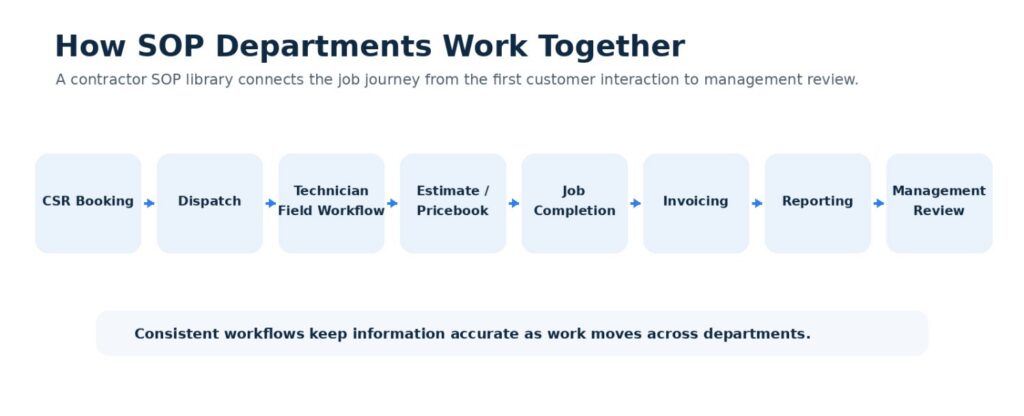
A contractor SOP library should not be viewed as a collection of unrelated documents.

The workflows connect with each other.

For example:

CSR booking → Dispatch → Technician field workflow → Estimate/Pricebook → Job completion → Invoicing → Reporting → Management review

If one department follows a different process from the next, information can become inconsistent as the job moves through the business.

A complete SOP library helps establish consistency across this entire workflow.
How SOPs Should Be Created and Maintained

Creating SOPs is only the beginning. They must remain current as your business evolves.

Outdated documentation quickly loses value and encourages employees to return to informal processes.

A sustainable SOP program includes:

  • Standardized formats: Use a combination of written materials and short tutorials to guide processes, which will be easier to understand visually.
  • Centralized documentation: Store SOPs in one well-organised place accessible to all team members.
  • Defined responsibilities: Delegate review and update of documentation to department managers.
  • Periodic updates: Update SOPs every time changes occur in workflow, pricing, software, and other services provided by the company.
  • Integration into training programs: Implement SOPs not only in onboarding but also in regular coaching.
  • Version control: Make sure employees can identify the current version of a process.

Continued maintenance of documentation as an integral part of operational activity will ensure consistent business development.

How Often Should a Contractor SOP Library Be Updated?

SOPs should be reviewed whenever there is a meaningful change to the business process, ServiceTitan configuration, pricing, services, organizational structure, or employee responsibilities.

A periodic review can also identify outdated procedures even when no major change has occurred.

The goal is to make the SOP library a living operational resource rather than a collection of documents that employees stop using.

How Titan Pro Technologies Builds SOP Libraries

dilling_hvac

Titan Pro Technologies helps contractors create structured SOP libraries that align with their ServiceTitan environment and operational goals.

Through Gold and Diamond Memberships, businesses receive customized documentation supported by practical training and continuous optimization.

The process includes:

  • Discovery: Review current workflows and identify documentation gaps or inconsistencies.
  • Process Design: Create SOP documents following the best practices of ServiceTitan and company processes.
  • Process Documentation: Create PDF manuals and videos for each department.
  • Implementation Support: Assist during process implementation using Training & Coaching.
  • Process Optimization: Adjust documentation when new services or processes emerge.
  • Performance Review: Connect documented processes with operational KPIs and identify areas for improvement.

This step-by-step process allows companies to decrease variance and ensure consistency among employees in their processes.

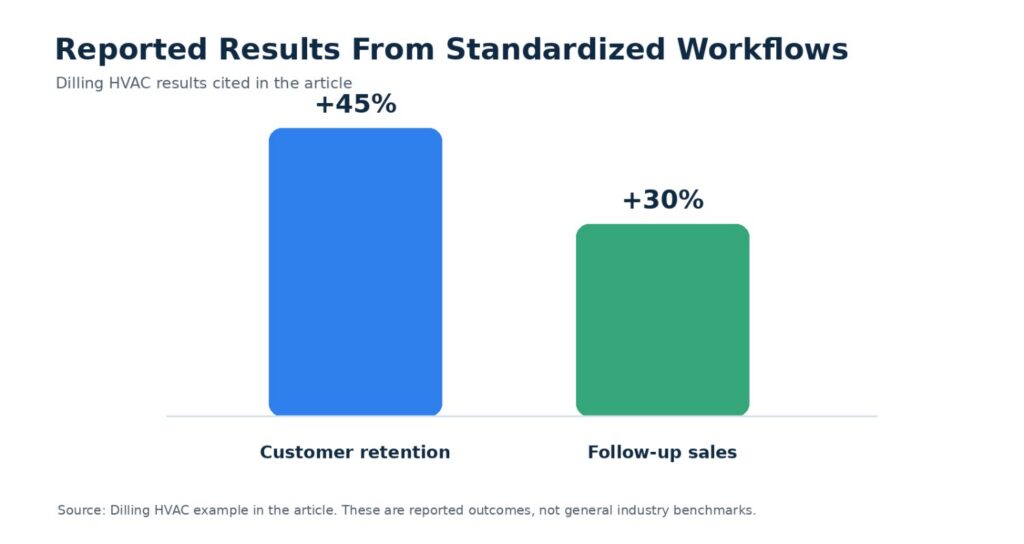
Titan Pro Technologies has been assisting contractors to optimize their processes and ServiceTitan operations. For instance, Dilling HVAC saw its customer retention increase by 45%, and its follow-up sales improved by 30%. It proves how standardized workflows can be used for business benefits.

What Makes a Customized SOP Library Different From Generic SOPs?

Generic SOPs describe common processes, but a customized SOP library is built around how a specific business operates.

A customized library can account for:

  • Company-specific roles.
  • Existing ServiceTitan configuration.
  • Department responsibilities.
  • Scheduling rules.
  • Service offerings.
  • Pricing processes.
  • Customer communication requirements.
  • Technician workflows.
  • Reporting requirements.
  • Management procedures.

This helps ensure employees are documenting and following processes that actually match the company’s operating model.


How Titan Pro Technologies Builds SOP Libraries

Titan Pro Technologies helps contractors create structured SOP libraries that align with their ServiceTitan environment and operational goals.

Through Gold and Diamond Memberships, businesses receive customized documentation supported by practical training and continuous optimization.

The process includes:

  • Discovery: Review current workflows and identify documentation gaps or inconsistencies.
  • Process Design: Create SOP documents following the best practices of ServiceTitan and company processes.
  • Process Documentation: Create PDF manuals and videos for each department.
  • Implementation Support: Assist during process implementation using Training & Coaching.
  • Process Optimization: Adjust documentation when new services or processes emerge.
  • Performance Review: Connect documented processes with operational KPIs and identify areas for improvement.

This step-by-step process allows companies to decrease variance and ensure consistency among employees in their processes.

Titan Pro Technologies has been assisting contractors to optimize their processes and ServiceTitan operations. For instance, Dilling HVAC saw its customer retention increase by 45%, and its follow-up sales improved by 30%. It proves how standardized workflows can be used for business benefits.

What Makes a Customized SOP Library Different From Generic SOPs?

Generic SOPs describe common processes, but a customized SOP library is built around how a specific business operates.

A customized library can account for:

  • Company-specific roles.
  • Existing ServiceTitan configuration.
  • Department responsibilities.
  • Scheduling rules.
  • Service offerings.
  • Pricing processes.
  • Customer communication requirements.
  • Technician workflows.
  • Reporting requirements.
  • Management procedures.

This helps ensure employees are documenting and following processes that actually match the company’s operating model.

How a Contractor SOP Library Supports Business Growth

A complete SOP library can help a growing service business move from employee-dependent operations toward process-driven operations.

The benefits include:

  • More consistent customer experiences.
  • Faster employee onboarding.
  • Better operational accountability.
  • More reliable ServiceTitan data.
  • More consistent reporting.
  • Reduced dependence on individual employee knowledge.
  • Easier management of growing teams.
  • More repeatable workflows across departments.
  • Better visibility into operational performance.
  • A stronger foundation for adding services, territories, or locations.

SOPs do not replace good employees or good management.

Instead, they give employees a documented framework that helps them perform their responsibilities consistently.

Final Takeaway

Growing contractors eventually reach a point where informal processes are no longer enough to maintain consistency.

When operational knowledge exists only in employees’ experience, the business becomes more difficult to train, manage, measure, and scale.

A complete contractor SOP library turns that knowledge into documented, repeatable processes across dispatch, customer service, field operations, accounting, and management.

ServiceTitan provides the technology, but SOPs define how the business uses that technology consistently.

The most effective SOP framework is:

Discover → Design → Document → Implement → Train → Measure → Optimize

Titan Pro Technologies helps home service businesses build this operational foundation through customized SOP libraries, PDF and video documentation, Training & Coaching, workflow assessment, ServiceTitan optimization, and ongoing operational support.

The result is a more repeatable operating system that can help contractors reduce process variation, improve onboarding, strengthen reporting, and build a stronger foundation for long-term growth.

Resource Pages

Frequently Asked Questions

What should a complete SOP library for a home service business include?

The SOP library needs to include all procedures for dispatch, customer service representatives, technicians, accountants, and leaders in relation to ServiceTitan.

Start by addressing critical operational parts such as booking, dispatching, tech workflows, communication and invoicing, and later expand to other departments.

The ownership of SOPs for each department can be assigned to dispatch managers, CSR managers, field managers, and accounting managers.

With documented SOPs, new employees receive instructions that help avoid unnecessary shadowing.

Titan Pro Technologies creates customized SOP libraries through Gold and Diamond Memberships, combining ServiceTitan optimization, PDF and video documentation, Training & Coaching, and ongoing operational support to help businesses maintain consistent processes as they grow.

Ready to keep growing? Titan Pro is here to help optimize your business operations. Whether it’s streamlining your dispatch or preparing for an edit with Private Equity, Titan Pro has the tools you need.

Share this post

Scroll to Top