Why ServiceTitan Reports Become Inaccurate During High Call Volume for Contractors

Table of Contents

Summary: When call volume spikes, small mistakes like skipped call classification, wrong job types, and mislinked recalls inflate total calls and lower reported booking rates. That distorts cost per lead, revenue forecasts, and staffing decisions. Even a small reporting error can trigger unnecessary ad spend or hiring.

When peak season hits, phones ring nonstop. More calls should mean more booked jobs and higher revenue. But many contractors notice something else first inside their ServiceTitan Optimization dashboards:

  • Booking rates drop
  • Abandoned calls increase
  • Dashboards stop matching reality
  • Revenue forecasts shift

The problem is rarely the software. The problem is what happens inside your workflows when call volume spikes. And peak demand is not random.

According to the U.S. Census Bureau, residential construction spending in the United States has exceeded $900 billion annually in recent years, reflecting sustained demand in housing and home services. The U.S. Bureau of Labor Statistics reports over 415,000 HVAC mechanics and installers employed nationwide, showing the scale of field service demand.

Demand increases. Call surges are predictable.
Your reporting system must scale with that pressure.

What Actually Breaks in ServiceTitan During High Call Volume

What Actually Breaks in ServiceTitan During High Call Volume

Booking Rate Appears Lower Than It Really Is

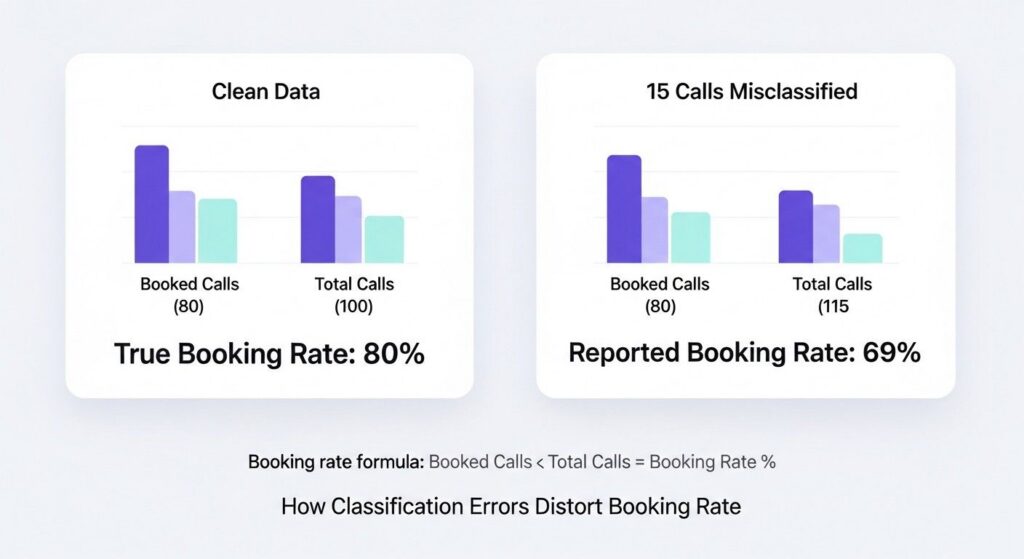
Booking rate formula:

Booked Calls ÷ Total Calls = Booking Rate %

During high call volume, CSRs work faster. Small steps get skipped. If the green bubble is not clicked properly, or calls are not classified correctly, total calls inflate artificially. That lowers the booking rate on your dashboard, even if real booking behavior did not change.

How Classification Errors Distort Booking Rate

Scenario

Booked Calls

Total Calls

True Booking Rate

Reported Booking Rate

Clean Data

80

100

80%

80%

15 Calls Misclassified

80

115

80%

69%

Small workflow gaps create large KPI distortions.
Abandoned Calls Increase on Paper

High call volume leads to:

  • Missed classification
  • Fast transfers
  • Multi-line answering
  • Callback confusion

When calls are not tagged correctly, ServiceTitan defaults them to “abandoned.” This affects:

  • CSR scorecards
  • Call center performance metrics
  • Staffing decisions
  • Revenue forecasting

The dashboard reflects input behavior. It does not guess intent.

Cost Per Lead Calculations Become Unreliable

Most contractors increase marketing spend during busy seasons.

The U.S. Small Business Administration notes that small businesses typically allocate 7–8% of gross revenue toward marketing and advertising. If booking rate reporting is distorted, contractors cannot accurately calculate:

  • True cost per lead
    • Revenue per inbound call
    • Marketing ROI
    • Break-even thresholds

Inaccurate call tracking = unreliable financial planning.

Why High Call Volume Magnifies Workflow Weaknesses

Cognitive Load Reduces Accuracy

The American Psychological Association confirms that high task load reduces accuracy in repetitive workflows. When CSRs handle more calls per hour:

  • Memory shortcuts increase
  • Classification gets skipped
  • Job types get rushed
  • Notes become inconsistent

Under pressure, speed increases. Accuracy declines.

Improper Job Type Selection Skews Revenue Segmentation

Under speed pressure, CSRs may:

  • Choose generic job types
  • Skip recall linking
  • Miss warranty indicators
  • Mislabel tech-generated leads

This distorts:

  • Revenue segmentation
  • Recall rates
  • Technician performance metrics
  • Service line profitability reports

Accurate job typing drives clean dashboards.

Failure to Separate Non-Revenue Calls Distorts KPIs

Not all inbound calls are revenue opportunities. Examples include:

  • Vendor calls
  • Hiring inquiries
  • Robocalls
  • Customer status checks

If these are not classified correctly, they count against booking rate. That unfairly lowers CSR conversion metrics.

How Reporting Instability Impacts Revenue Forecasting

How Reporting Instability Impacts Revenue Forecasting

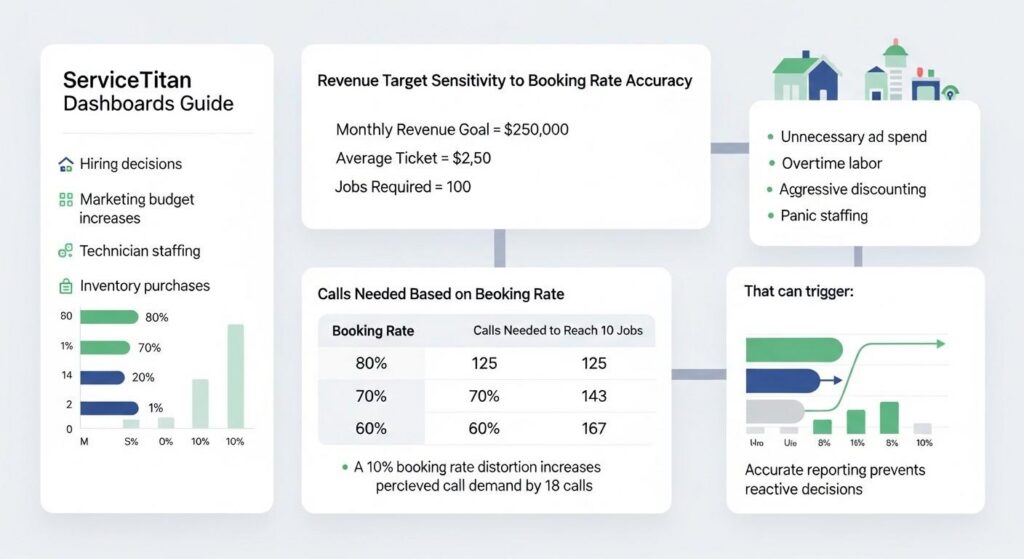
ServiceTitan dashboards guide:

  • Hiring decisions
  • Marketing budget increases
  • Technician staffing
  • Fleet expansion
  • Inventory purchases

When booking rate appears lower than reality, leadership compensates incorrectly.

Revenue Target Sensitivity to Booking Rate Accuracy

Example:

Monthly Revenue Goal = $250,000
Average Ticket = $2,500

Jobs Required = 100

Calls Needed Based on Booking Rate

Booking Rate

Calls Needed to Reach 100 Jobs

80%

125

70%

143

60%

167

A 10% booking rate distortion increases perceived call demand by 18 calls.

That can trigger:

  • Unnecessary ad spend
  • Overtime labor
  • Aggressive discounting
  • Panic staffing

Accurate reporting prevents reactive decisions.

AI and Automation Increase the Risk of Inaccurate Data

AI adoption in the trades continues to grow. Recent industry data shows:

  • 46% of contractors are already using or experimenting with AI
  • 74% believe AI improves operational efficiency

AI forecasting depends on historical data accuracy. If peak season classification errors distort that data:

  • Predictive scheduling becomes unreliable
  • Capacity planning fails
  • Revenue forecasting misfires

Automation amplifies clean systems. It exposes weak ones.

Operational Safeguards to Protect Reporting During Peak Season

High call volume does not create reporting problems. It reveals them. Here are structural safeguards contractors must implement.

Implement Daily Abandoned Call Reviews During Peak Months

Managers should:

  • Review abandoned call logs daily
  • Reclassify mis-tagged calls
  • Coach CSRs immediately
  • Identify repeated workflow breakdowns

Weekly review cycles are too slow during busy periods.

Standardize Call Flow Structure

Every CSR call should follow a consistent framework:

  • Greeting
  • Qualification
  • Clarification
  • Reassurance
  • Scheduling
  • Confirmation

Structured calls reduce cognitive strain.

Optimize Job Summary and Custom Fields

Each job type should include:

  • Minimum five qualification prompts
  • Warranty verification triggers
  • Recall identification fields
  • Objection documentation

This reduces memory reliance during high call flow.

Create a Peak Season KPI Dashboard

Monitor daily:

  • Booking rate by CSR
  • Abandoned calls
  • Revenue per booked job
  • Cost per lead
  • Average call duration

If booking rate drops during increased volume, investigate classification first.

The Financial Risk of Ignoring Reporting Breakdown

Consider this scenario:

  • 250 calls in one heatwave week
  • 20 misclassified
  • $3,000 average ticket

If even five of those become untracked opportunities:

That equals $15,000 in invisible revenue potential.

Multiply that across 10 peak weeks.

Small reporting gaps compound quickly.

Why This Is an Optimization Issue, Not a Software Failure

ServiceTitan provides:

  • Call tracking
  • Classification systems
  • Custom dashboards
  • Recall and warranty linking
  • KPI segmentation

But systems only reflect user behavior. Operational structure determines reporting accuracy.

How Titan Pro Technologies Stabilizes ServiceTitan Reporting

Titan Pro Technologies is a ServiceTitan Certified Provider based in Blue Bell, Pennsylvania.

We specialize in:

  • Call center workflow optimization
  • Peak season readiness audits
  • KPI dashboard architecture
  • CSR training systems
  • Revenue-aligned reporting design
  • ServiceTitan configuration and support

We ensure your reports improve under pressure.

Peak Season Should Build Confidence

High call volume is predictable.

  • Construction spending remains strong.
  • Trade employment remains high.
  • Service demand continues to grow.

Your ServiceTitan system must be structured to handle peak demand.

If your reports break during call surges, the issue is workflow architecture, not software.

Request a Free ServiceTitan Assessment
Titan Pro Technologies will evaluate how your reporting system performs under peak volume pressure.

Frequently Asked Questions

Increased call volume often leads to misclassification and abandoned call inflation, which lowers reported booking rates.

Unclassified calls inflate total call counts, distorting booking rate calculations and CSR performance metrics.

Daily review is recommended during peak demand to prevent cumulative reporting distortion.

No. AI relies on clean historical input data. Inaccurate classification undermines predictive tools.

We optimize workflows, dashboards, and CSR processes so your ServiceTitan system remains accurate during high call volume.

Ready to keep growing? Titan Pro is here to help optimize your business operations. Whether it’s streamlining your dispatch or preparing for an edit with Private Equity, Titan Pro has the tools you need.

Share this post

Scroll to Top