Skip to content




Roofing and HVAC companies do not lose control during busy season.
They lose control months before it begins. When demand spikes, weak scheduling systems collapse. Dispatch boards overflow. Technicians burn out. High-value install opportunities get buried under low-margin service calls. Revenue increases, but profit does not.
The U.S. Bureau of Labor Statistics projects steady growth for HVAC technicians, driven by climate systems demand and replacement cycles. Demand is not the problem, preparation is.
This guide explains how roofing and HVAC services can optimize ServiceTitan scheduling before busy season so they scale with control, protect margins, and increase install revenue.
Why Scheduling Breaks During Busy Season

Busy season exposes operational weaknesses.
When your phone volume doubles, your scheduling system must answer four questions instantly:
- Which calls get priority?
- Which jobs should be rescheduled?
- Which technician should handle the call?
- When do we stop booking?
Without rules, everything feels urgent. Dispatch becomes reactive. Technicians work overtime. Low-value calls crowd out high-revenue installs.
ServiceTitan has powerful scheduling capabilities. But software alone does not create structure. Configuration and workflow discipline do.
What Optimized Scheduling Really Means
Optimized scheduling is not about filling every time slot.
It means aligning revenue opportunity, technician skill, geography, and capacity into one clear system.
In ServiceTitan, optimized scheduling includes:
- Opportunity tagging
- Capacity guardrails
- Revenue-per-tech tracking
- Geographic zoning
- Tiered priority fees
- Standardized rescheduling policies
- Install board protection rules
When these systems are built before demand spikes, busy season becomes controlled growth instead of chaos.
Start 90 Days Before Busy Season
If summer is your peak, start in spring. If storm season drives roofing demand, start before the weather shifts. Waiting until phones ring off the hook is too late.
Preparation should begin 60 to 90 days before expected demand increases.
Audit Your Current Dispatch Workflow
Before changing anything, measure what is happening today.
Inside ServiceTitan, review:
- Average revenue per job type
- Install conversion rate
- Revenue per technician
- Cancellation rate
- Overtime hours
- Average drive time between calls
- Same-day fill rate
Look for patterns. Are high-value install calls being scheduled days out? Are techs driving 30–40 minutes between jobs? Is overtime common by mid-week?
These signals show where your scheduling structure needs adjustment.
Implement Opportunity Tagging Rules
Not every call deserves equal priority.
Opportunity-based scheduling protects revenue.
Inside ServiceTitan, build tagging rules that flag high-value calls. For HVAC companies, this might include:
- Equipment older than 10 years
- No maintenance agreement
- Major mechanical failures
- Repeated service history
For roofing companies:
- Roof nearing end-of-life
- Leak after storm damage
- Visible structural deterioration
- Insurance claim-related inquiries
When calls are tagged correctly, dispatch can prioritize install opportunities over low-margin maintenance work during peak capacity.
Without tagging, high-value jobs hide inside generic service calls.
Create Tiered Priority Scheduling Fees
When demand spikes, urgency must be managed.
A tiered diagnostic or priority service fee model allows customers to self-select urgency.
Example structure:
- Same-day priority service – premium fee
- Next-day service – standard rate
- Flexible scheduling – discounted rate
This does not punish customers. It creates transparency.
Customers who need immediate help can choose priority. Others can wait and pay less.
This approach protects technician capacity while maintaining customer trust.
Build a Catch-and-Release Dispatch Policy
Capacity is limited. Once your install board is full, you must protect it.
A catch-and-release policy works like this:
- Catch high-opportunity calls immediately
- Release low-margin or non-urgent jobs
- Reschedule maintenance work
- Protect technician recovery time
Some customers may be frustrated by rescheduling. But the real scarcity is technician energy, not customer demand.
Companies that protect their workforce outperform those who try to please everyone.
Assign the Right Technician Using Revenue Data
High-opportunity calls require high-performing technicians.
Inside ServiceTitan, track:
- Revenue per opportunity call
- Close rate on replacement leads
- Average ticket value
- Sold revenue divided by opportunity calls
When you know which technician converts at the highest rate, assign that technician to high-value calls.
This is not favoritism. It is strategy.
The goal is consistent performance, like a franchise operation. Every technician should follow the same documented process. Over time, performance variance shrinks.
Optimize Geographic Scheduling Zones
Drive time quietly kills profit.
If technicians drive 30 minutes between jobs during peak demand, you lose install capacity.
Create geographic guardrails:
- Limit service radius
- Cluster jobs by zip code
- Track average windshield time
- Monitor revenue per mile
Many successful HVAC and roofing companies focus heavily on core service areas instead of spreading thin across regions.
Concentrated geography increases efficiency and same-day capacity.
Strengthen Membership and Maintenance Plan Integration
Companies with strong service agreement programs enter busy season with stability.
Maintenance plans provide:
- Predictable recurring revenue
- Pre-scheduled tune-ups
- Higher replacement conversion rates
- Stronger customer retention
Before busy season, review:
- Service agreement renewal rate
- Membership penetration percentage
- Revenue generated from agreement customers
- Average ticket for members vs non-members
Customers on maintenance plans are easier to schedule and more likely to approve replacement recommendations.
Recurring revenue smooths seasonality.
Align Pricebook With Scheduling Strategy
Scheduling only works if job durations and pricing are accurate.
Review your pricebook:
- Are labor hours realistic?
- Are install blocks properly estimated?
- Are good-better-best options clear?
- Are flat-rate tasks aligned with field reality?
If job durations are underestimated, your schedule will constantly overflow. If they are overestimated, you lose daily capacity.
Pricebook accuracy directly affects scheduling stability.
Build Custom Dashboards for Real-Time Visibility
The busy season requires live decision-making.
Inside ServiceTitan, build dashboards that track:
- Daily booked revenue
- Open technician capacity
- Install board saturation
- Revenue per technician
- Opportunity call volume
- Average drive time
- Same-day booking percentage
Real-time reporting allows managers to adjust before problems escalate.
Waiting until end-of-month reports creates reactive management.
Train CSRs and Dispatchers Before Demand Surges
Scheduling discipline starts on the first phone call.
CSRs must know how to:
- Ask equipment age questions
- Identify opportunity signals
- Explain priority service fees clearly
- Position maintenance plans naturally
- Set realistic scheduling expectations
Dispatchers must know when to:
- Protect install capacity
- Reschedule low-priority calls
- Monitor technician workload
- Prevent overtime burnout
Standardized scripts and documented procedures reduce inconsistency.
Consistency builds scalability.
Plan Technician Capacity in Advance
Busy season strain often begins with staffing shortages.
Before demand spikes:
- Forecast call volume trends
- Review install board history
- Analyze seasonal labor needs
- Identify hiring gaps
- Begin recruitment early
Do not wait until summer to scramble for technicians.
Capacity planning supports scheduling optimization.
What Happens When Scheduling Is Optimized
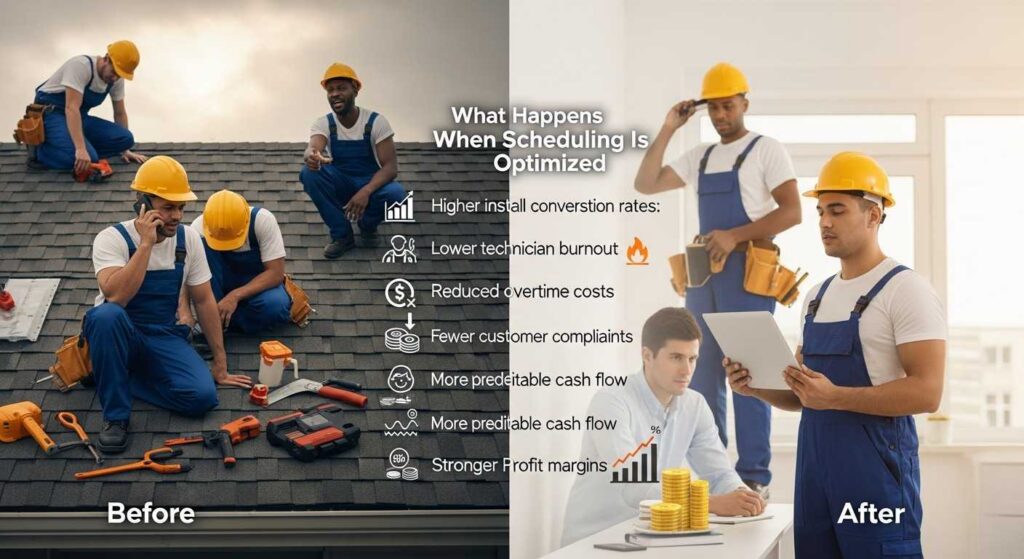
Roofing and HVAC companies that prepare early experience:
- Higher install conversion rates
Your best technicians handle the right opportunities at the right time, increasing close rates on high-value jobs. - Lower technician burnout
Balanced capacity and structured dispatch reduce overtime and protect workforce energy. - Reduced overtime costs
Accurate job durations and capacity guardrails eliminate unnecessary late-day extensions. - Fewer customer complaints
Clear expectations, realistic scheduling windows, and priority transparency improve satisfaction. - More predictable cash flow
Install boards fill strategically, not randomly, stabilizing revenue week over week. - Stronger profit margins
High-opportunity calls are prioritized, low-margin jobs are filtered, and drive time is minimized. - Busy season becomes profitable growth instead of operational stress.
Demand no longer overwhelms your team; it fuels controlled, scalable expansion.
Why Most Companies Wait Too Long
Most owners focus on lead volume. More calls feel like growth. But without scheduling structure, more demand creates:
- Overbooked technicians
- Buried install opportunities
- Rising overtime
- Shrinking margins
Marketing fills the calendar. Operations protect the profit.
The companies that win during busy season are not reacting to demand. They prepared before it arrived.
How Titan Pro Technologies Helps
Titan Pro Technologies is a ServiceTitan Certified Provider based in Blue Bell, Pennsylvania.
We help roofing and HVAC businesses maximize their ServiceTitan platform through:
- Scheduling workflow design
- Opportunity tagging architecture
- Dispatch SOP development
- Custom dashboard configuration
- Pricebook optimization
- Membership program alignment
- CSR and dispatcher training
- Ongoing system optimization
ServiceTitan already has powerful capabilities. The difference is configuration, reporting discipline, and execution.
We help companies turn software into measurable operational advantage.
Conclusion: Busy Season Rewards Preparation
Every busy season follows the same pattern.
Call volume surges. Schedules tighten. Install boards fill. Technicians hit capacity.
The only question is whether your system is ready for it.
If your peak demand begins in June, preparation must begin now; not when the calendar is already full.
Optimize your scheduling workflows. Protect your install board. Train your team. Build your dashboards. Strengthen your pricebook. Expand your maintenance agreements.
When demand spikes, your operations should respond with structure, not stress.
Get a pre-busy-season scheduling audit and ensure your ServiceTitan platform is configured for controlled, profitable growth.
Frequently Asked Questions
Begin 60 to 90 days before expected demand spikes. This allows time for tagging updates, pricebook adjustments, dashboard creation, and team training.
It is a system that prioritizes high-revenue or high-conversion jobs using defined criteria such as equipment age, job type, or service history.
No. It gives customers control over urgency while protecting technician capacity and improving transparency.
Real-time dashboards allow managers to track revenue, open capacity, technician performance, and install board status before bottlenecks form.
Roofing, HVAC, plumbing, electrical, and other seasonal home service businesses benefit significantly due to fluctuating demand patterns.