Why Roofing and HVAC Contractors Miss Calls During Peak Season in ServiceTitan

Summary: Peak season does not cause missed calls. Weak systems do. HVAC and roofing contractors lose revenue during surge months because call intake, dispatch workflows, and after-hours coverage are not built for high demand.
Peak season should be the most profitable time of year for HVAC and roofing companies . Demand surges. Phones ring nonstop. Schedules fill within hours. Yet many companies still miss calls, even while using ServiceTitan. That’s not a marketing problem. It’s an operational one. According to the U.S. Energy Information Administration, 88% of U.S. households use air conditioning . When heatwaves hit, call volume spikes fast. The U.S. Bureau of Labor Statistics also projects 6% growth in HVAC employment from 2022 to 2034 , showing demand isn’t slowing down. So if demand is strong, why are contractors still missing calls during their busiest months? Let’s break it down.

What Happens During Peak Season

What Happens During Peak Season

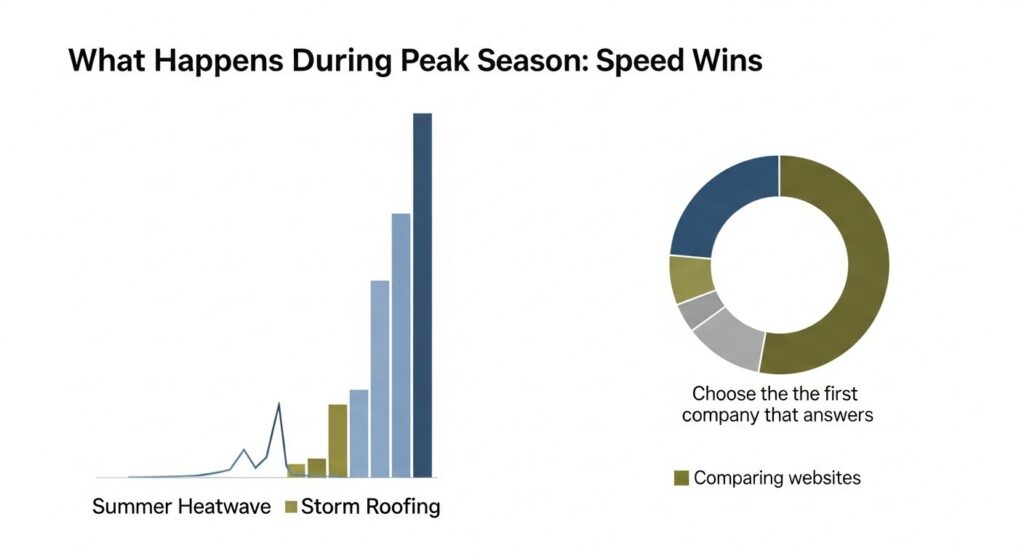
Peak season does not build slowly. It hits all at once.

For HVAC contractors, summer heatwaves trigger emergency repair calls. Homeowners need cooling restored immediately. Commercial properties cannot afford system downtime.

For roofing companies, storms, hail, and heavy rain create urgent leak repairs and insurance-driven inspections. Spring and fall bring strong replacement demand. Weather drives urgency overnight.

Call volume does not increase evenly. It surges.

During these moments, customers are not comparing websites. They are looking for the first company that answers.

In peak season, speed wins.
The Real Cost of a Missed Call

The Real Cost of a Missed Call

Most missed calls during peak season are not casual questions. They are urgent, ready-to-book jobs.

  • A broken AC in 95-degree heat.
  • A leaking roof after a storm.
  • An inspection needed before closing.

When no one answers, the customer calls the next contractor. That means:

  • The repair revenue is gone
  • The upsell is gone
  • The long-term customer is gone

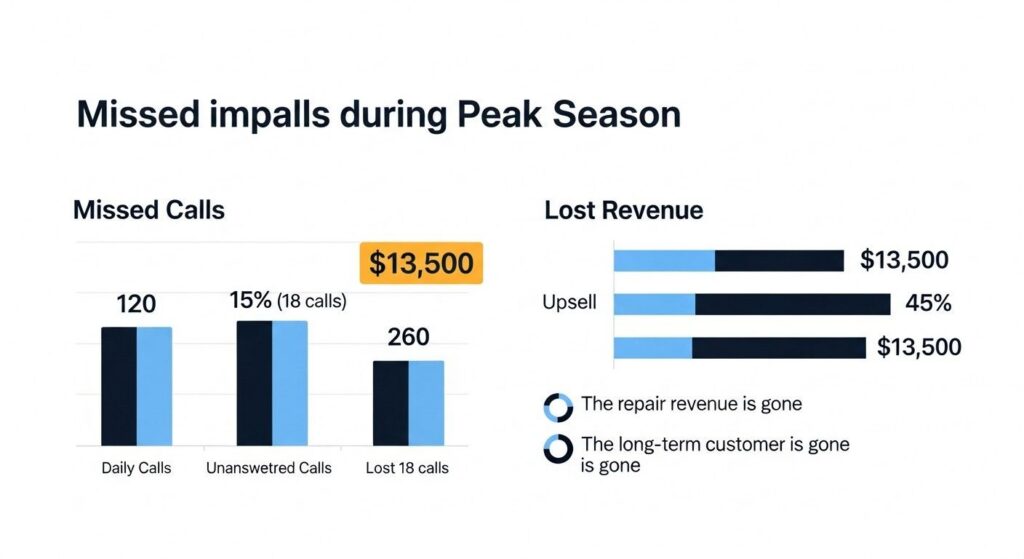
Now look at the numbers.

If your company receives 120 calls per day during a heatwave and 15% go unanswered, that’s 18 missed jobs daily.

At a $750 average ticket, that’s $13,500 lost in one day.

Peak season doesn’t forgive missed calls. It multiplies them.
Why Roofing and HVAC Contractors Miss Calls During Peak Season

Peak season chaos is not random. It is the result of system design. When demand spikes, weak workflows break. Here are the most common causes.

1. Staffing for Shoulder Season Instead of Surge

Many contractors staff their CSR team for average call volume. That works in slower months. It fails during peak season. When call volume doubles or triples:

  • Hold times increase
  • Calls go unanswered
  • CSRs rush through intake
  • Booking errors rise
  • Burnout increases

Adding people alone is not the solution. But planning for average demand during peak season guarantees problems.

2. No Seasonal Forecasting

Some companies rely on memory instead of reporting. They do not track:

  • Call volume by month
  • Booking conversion rates
  • Missed call percentage
  • After-hours patterns

Without data, peak season feels sudden every year. It isn’t sudden. It is predictable.

3. Poorly Configured Call Booking in ServiceTitan

ServiceTitan is powerful. But it must be configured correctly. If call booking lacks:

  • Required intake fields
  • Structured scripts
  • Equipment history visibility
  • Clear job-type tagging

Dispatch becomes guesswork.

Technicians arrive unprepared. Jobs get rescheduled. Frustration grows. Peak season exposes these weaknesses fast.

4. Dispatch Bottlenecks During Emergency Surges

Not all calls carry the same urgency. An emergency AC failure should not sit behind routine maintenance. A roof leak after a storm should not wait in a general queue. Without skill-based routing and priority tagging:

  • Emergency jobs get delayed
  • Technicians are misassigned
  • Overtime increases
  • Revenue is lost

Peak season requires defined routing rules.

5. No After-Hours or Overflow Strategy

Many contractors still rely on voicemail after hours.

In 2026, that costs jobs. When temperatures spike at night, customers do not leave messages. They call the next company. If no overflow or escalation protocol exists, you lose the booking. After-hours coverage must be integrated into your system, not treated as an afterthought.

6. Lack of KPI Tracking

If you do not measure it, you cannot fix it. Many contractors fail to track:

  • Call-to-book rate
    • Call abandonment rate
  • Revenue per inbound call
  • Membership attach rate

Without dashboards, missed calls remain invisible. And invisible problems never get solved.

How to Configure ServiceTitan for Peak Season Success

Peak season does not have to feel overwhelming. When ServiceTitan is configured intentionally, high demand becomes an advantage — not a disruption.

Here’s what a peak-ready system looks like.

1. Streamlined Call Booking Workflows

Every inbound call should move through a clear, consistent process.

  • Required fields for equipment type and issue
  • Built-in prompts to identify urgency
  • Automatic call recording for coaching and quality
  • Instant access to customer and equipment history

Structured intake improves booking speed, accuracy, and customer confidence.

2. Smart, Skill-Based Dispatch

Peak season runs smoothly when teams are organized by function.

  • Dedicated emergency repair technicians
  • Separate maintenance routes
  • Installation crews with protected schedules

Emergency jobs should auto-prioritize. Time blocks should reflect realistic surge conditions.

Skill-based routing keeps operations controlled even when volume rises.

3. Real-Time Performance Dashboards

Visibility creates confidence.

Daily peak-season tracking should include:

  • Total inbound calls
  • Answer rate
  • Booking conversion rate
  • Revenue per technician
  • Membership attach rate

With the right dashboards, adjustments can happen in real time — not weeks later.

4. Reliable After-Hours Coverage

Peak demand does not stop at 5 PM.

A prepared system includes:

  • Clear on-call rotation schedules
  • Integrated overflow answering support
  • Priority escalation tagging
  • Automated confirmations and updates

This ensures urgent customers always reach a live path forward.

Why Shoulder Season Determines Peak Season Performance

Peak season success is rarely built during peak season.

The companies that thrive when demand surges prepare months in advance. They use shoulder season to strengthen their operational foundation instead of coasting through slower volume.

Shoulder season is the time to:

  • Strengthen CSR scripts and booking consistency
  • Refine dispatch rules and routing logic
  • Optimize pricebook structure and estimating flow
  • Audit reporting dashboards for real-time visibility
  • Review prior peak-season performance metrics

When preparation happens early, peak season feels controlled instead of chaotic.

How Membership Revenue Stabilizes Seasonal Demand

Peak season spikes are unpredictable. Membership revenue is not.

Preventive maintenance programs create consistent customer touchpoints and smoother scheduling throughout the year. Instead of relying only on emergency demand, contractors build recurring revenue.

Members are more likely to:

  • Call your company first
  • Schedule proactively instead of reactively
  • Renew services year after year
  • Accept upgrades and long-term recommendations

Service agreements reduce revenue volatility, improve routing predictability, and increase customer lifetime value.

Owning the lifecycle of the system or roof strengthens long-term profitability.

Why System Design Determines Peak Season Profitability

Peak season tests operational structure. When demand rises, companies with clear systems stay in control. They rely on:

  • Structured call intake
  • Skill-based dispatch
  • Emergency prioritization
  • Real-time performance tracking

These foundations keep jobs moving and revenue scaling.

Without structure, higher volume creates delays, missed calls, and inefficiency. Peak season does not reward size. It rewards preparation. Strong systems turn demand into margin.

How Titan Pro Technologies Helps Contractors Capture Peak Season Revenue

How Titan Pro Technologies Helps Contractors Capture Peak Season Revenue

Titan Pro Technologies is a ServiceTitan Certified Provider based in Blue Bell, Pennsylvania. We specialize in helping HVAC and roofing contractors maximize their ServiceTitan platform.

We focus on structure, not surface fixes.

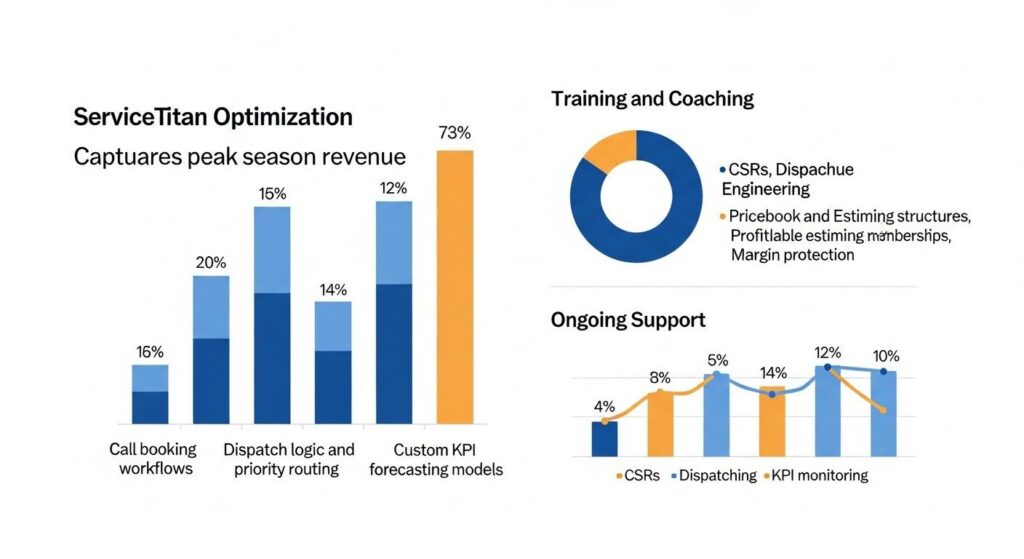
ServiceTitan Optimization

We configure:

  • Call booking workflows
  • Dispatch logic and priority routing
  • Custom KPI dashboards
  • Seasonal forecasting models

Training and Coaching

We train:

  • CSRs on structured intake scripts
  • Dispatchers on workflow efficiency
  • Technicians on good-better-best estimating

Pricebook and Revenue Engineering

We help contractors:

  • Build profitable estimating structures
  • Attach memberships consistently
  • Protect margins during peak demand

Ongoing Support

We monitor KPIs continuously and refine systems as demand shifts.
Peak season should not feel overwhelming. It should feel controlled.


Don’t Let Peak Season Become Peak Chaos

Peak season is predictable. Demand surges every year. If you are missing calls, the issue is not market demand. It is a system configuration.

HVAC and roofing contractors who optimize ServiceTitan before the surge capture more revenue, reduce stress, and scale profitably. Titan Pro Technologies helps you build that system.

If you want every call captured, routed, and converted this season, schedule a free discovery call at https://titanprotechnologies.com/contact/ 

Prepare before the next heatwave or storm hits.

Ready to keep growing? Titan Pro is here to help optimize your business operations. Whether it’s streamlining your dispatch or preparing for an edit with Private Equity, Titan Pro has the tools you need.

Share this post

Scroll to Top