When pWhen the temperature hits 95 degrees or a hailstorm tears through a neighborhood, the phone does not ring slowly.
It explodes.
For HVAC and roofing contractors, high-demand periods create massive opportunities. But they also expose operational gaps. And the biggest gap is not marketing.
It is missed calls.
During peak season, every unanswered ring is revenue walking straight to your competitor.
eak season hits, phones ring nonstop. More calls should mean more booked jobs and higher revenue. But many contractors notice something else first inside their ServiceTitan Optimization dashboards:
- Booking rates drop
- Abandoned calls increase
- Dashboards stop matching reality
- Revenue forecasts shift
The problem is rarely the software. The problem is what happens inside your workflows when call volume spikes. And peak demand is not random.
According to the U.S. Census Bureau, residential construction spending in the United States has exceeded $900 billion annually in recent years, reflecting sustained demand in housing and home services. The U.S. Bureau of Labor Statistics reports over 415,000 HVAC mechanics and installers employed nationwide, showing the scale of field service demand.
Demand increases. Call surges are predictable.
Your reporting system must scale with that pressure.
Why High-Demand Periods Multiply Missed Call Risk
- 2x–3x normal call volume
- Increased emergency calls
- More after-hours demand
- Overloaded dispatch boards
- Stretched CSR teams
The Revenue Math: What Missed Calls Actually Cost

Missed calls during slow months hurt. Missed calls during high-demand periods multiply losses.
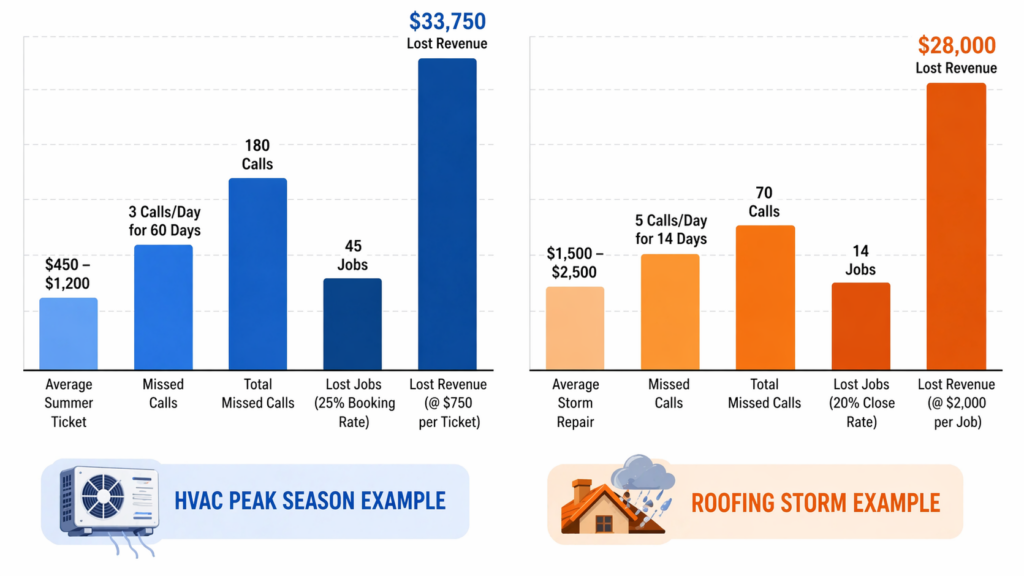
HVAC Peak Season Example
- Average summer ticket: $450–$1,200
- Miss 3 calls per day during a 60-day heat wave
- That equals 180 missed calls
Even at a 25% booking rate:
180 × 25% = 45 lost jobs
At a $750 average ticket:
45 × $750 = $33,750 lost revenue
Roofing Storm Example
- Average storm repair: $1,500–$2,500
- Miss 5 calls per day for 14 days
- That equals 70 missed calls
At a 20% close rate:
70 × 20% = 14 lost jobs
At $2,000 average:
14 × $2,000 = $28,000 lost revenue
And that is from just one demand surge.
How Missed Calls Reduce the ROI of Your Marketing Spend
Every inbound call is generated by paid effort.
You invested in:
- Google Ads
- Local Service Ads
- SEO
- Vehicle branding
- Direct mail
If a paid call goes unanswered, that lead moves to a competitor.
During high-demand periods, even a small drop in answer rate can reduce marketing ROI significantly. Marketing drives demand. Call performance determines revenue.
Why Peak Season Exposes Weak Call Handling Workflows
When demand spikes:
- Call volume increases rapidly
- CSRs handle back-to-back inquiries
- Dispatch fills quickly
- After-hours calls rise
Without optimized overflow routing and staffing alignment, calls get missed. High-demand periods do not create the problem. They expose workflow gaps that already exist.
Why Speed to Answer Directly Impacts Booking Rates
During emergencies, customers contact multiple contractors. The first contractor who answers often wins the job. Long hold times and voicemail reduce conversion rates. Faster response improves:
- Booking rate
- Close rate
- Customer trust
Speed is a measurable KPI during peak season.
How ServiceTitan Configuration Affects Call Answer and Booking Performance
ServiceTitan tracks:
- Inbound calls
- Booking rates
- Dispatch capacity
- After-hours activity
However, performance depends on configuration. Without optimized:
- Call routing
- Overflow settings
- After-hours workflows
- Capacity planning
Call answer rate and booking rate decline during demand spikes. Proper configuration allows contractors to capture more high-demand opportunities.
Key KPIs HVAC and Roofing Contractors Must Track During Peak Season

What gets measured improves. Peak season requires daily KPI visibility.
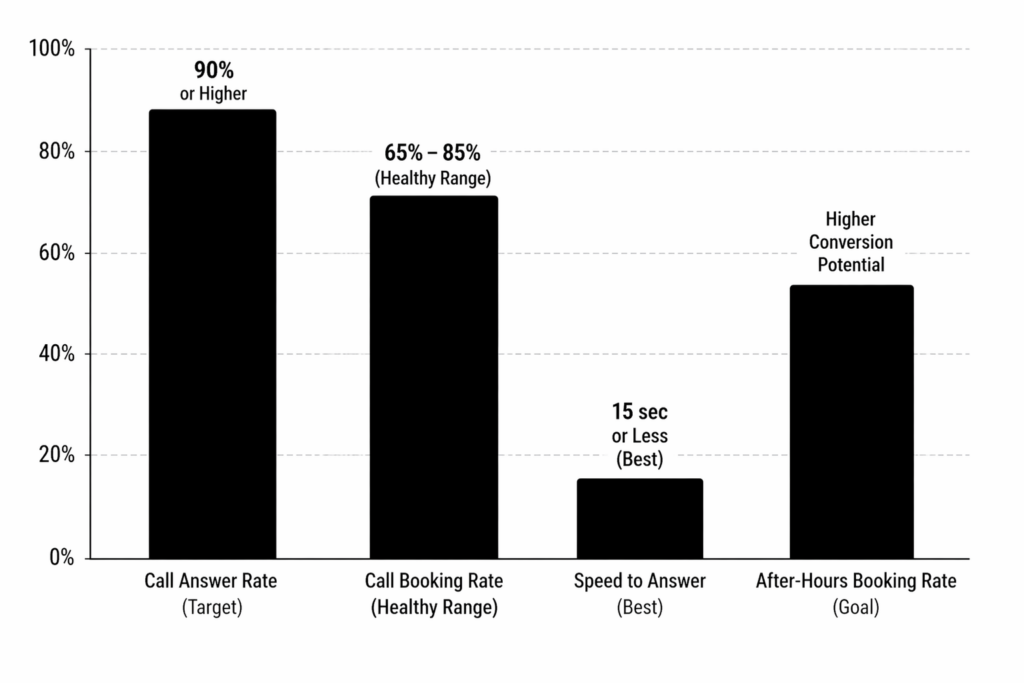
Call Answer Rate
Definition:
Call answer rate = answered calls ÷ total inbound calls.
Target during peak season: 90% or higher
Anything below 85% during demand spikes indicates revenue leakage.
Call Booking Rate
Definition:
Call booking rate = booked jobs ÷ answered calls.
Healthy range: 65%–85%, depending on trade and scripts.
If calls are answered but not booked, workflow or training gaps exist.
Speed to Answer
Seconds matter during emergencies. Even short delays increase hang-ups.
After-Hours Booking Rate
Storms and heat waves do not follow business hours. Evening and weekend calls often convert at high rates. If those calls are not handled correctly, revenue disappears.
Request a Free ServiceTitan Assessment
Titan Pro Technologies can review your call routing, booking rate KPIs, and peak-season workflows to help you capture every high-demand opportunity.

Peak Season: Fully Booked vs Fully Optimized
Scenario | What It Looks Like | What It Actually Means |
Fully Booked | Dispatch board is full | Some inbound calls may have gone unanswered |
High Call Volume | CSRs are busy all day | Booking rate may be dropping |
Technicians Scheduled | Jobs are stacked | Overflow routing may be failing |
“We Were Slammed” | Team feels maxed out | Demand may have exceeded system capacity |
Even if your schedule is full, missed inbound calls indicate unrealized revenue. Peak demand does not just test workload. It tests workflow efficiency.
Peak Season Optimization Playbook
Before Peak Season
- Audit call answer rate
- Review CSR scripts
- Stress-test overflow routing
- Configure after-hours workflows
- Align dispatch capacity
During Peak Season
- Monitor call KPIs daily
- Adjust staffing weekly
- Track missed call reports
- Review booking rate performance
- Optimize emergency scheduling
After Peak Season
- Analyze missed call data
- Identify bottlenecks
- Refine routing rules
- Update staffing strategy
Demand spikes are predictable.
Operational readiness must be proactive.
How Titan Pro Technologies Helps HVAC and Roofing Contractors Capture Every Call
Titan Pro Technologies is a ServiceTitan Certified Provider based in Blue Bell, Pennsylvania. We help home service businesses transform ServiceTitan into a performance engine. For roofing and HVAC sevices and contractor we provide:
- Call routing optimization
- Overflow configuration
- After-hours workflow setup
- CSR coaching to improve booking rates
- Dispatch capacity alignment
- Custom KPI dashboards
- Pricebook optimization to increase average ticket value
We do not replace your systems. We maximize them.
Every Ring Is Revenue
High-demand periods are short. Opportunities move fast. Customers call once. If your team does not answer, someone else will. Peak season should increase profitability, not expose operational weaknesses.
Request a Free ServiceTitan Assessment Today
Let Titan Pro Technologies help you optimize your call workflows, improve booking rates, and turn every high-demand surge into measurable growth.
Frequently Asked Questions
Call volume spikes suddenly. CSRs become overwhelmed. Overflow routing may not be optimized for demand surges.
Even missing 3–5 calls per day during a two-week storm surge can cost tens of thousands of dollars in lost booked jobs.
Roofing and HVAC contractors should target 90% or higher during high-demand periods.
Yes. ServiceTitan tracks inbound calls and booking rates, but workflows must be configured correctly to prevent leakage.
Through routing optimization, CSR coaching, KPI dashboards, overflow configuration, and peak-season operational planning.