Skip to content




Even a 10% drop in booking rate during a surge week can cost tens of thousands in lost revenue.
What High Call Volume Actually Means for Home Service Businesses
High call volume is not just “a lot of calls.”
In HVAC, plumbing, roofing, electrical, and garage door services, high call volume happens when inbound demand exceeds your ability to answer, qualify, book, and dispatch efficiently.
It shows up in measurable strain:
- Speed to answer slows down
- Abandoned calls increase
- Booking rate drops
- CSRs rush or hesitate
- Dispatch boards overload
- Same-day capacity disappears
If those metrics shift during surge weeks, your system is under pressure. And pressure reveals weak workflow design.
Why Demand Spikes Are Predictable
Seasonal demand in the trades follows clear patterns.
When temperatures rise, cooling systems fail more often. The EIA confirms that nearly nine out of ten U.S. homes use air conditioning. That means extreme heat impacts millions of systems simultaneously.
When hailstorms move through a region, roofing damage inspections surge. The National Weather Service estimates close to $1 billion in annual hail-related property and crop damage.
These events are not surprises. If your workflows are not prepared for predictable demand, your business absorbs unnecessary revenue loss.
Operational Warning Signs That Your ServiceTitan Workflow Is Breaking
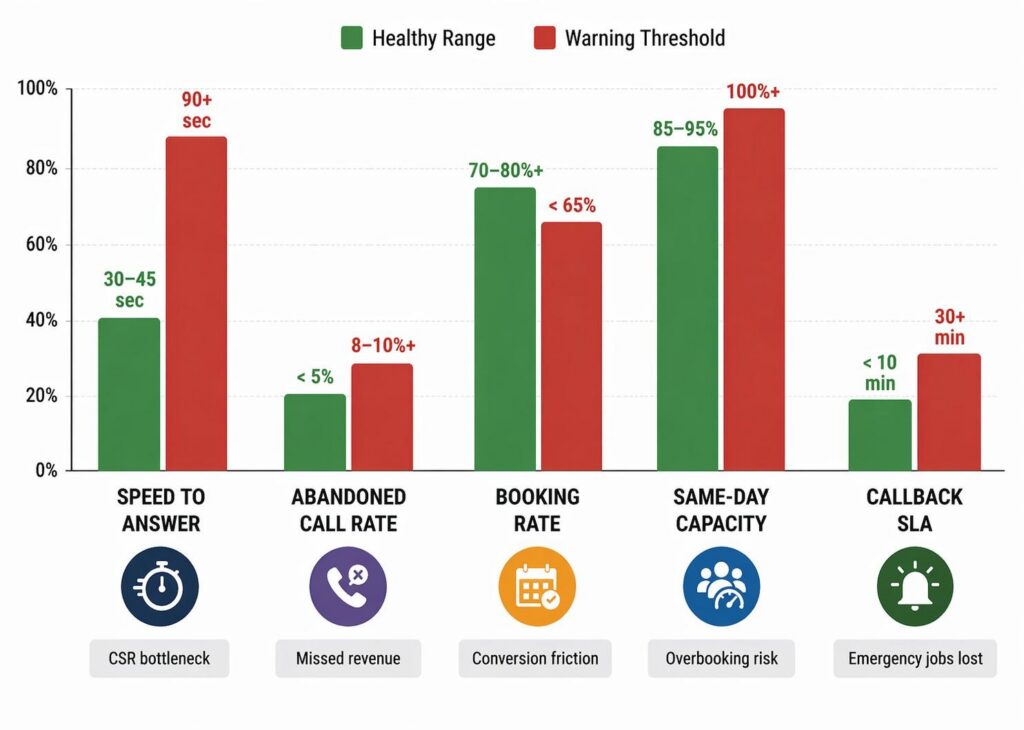
High call volume does not break a strong system. It exposes a weak one. Below are the clearest warning indicators.
Workflow Health Indicators During Peak Demand
Metric | Healthy Range | Warning Threshold | What It Signals |
Speed to Answer | 30–45 seconds | 90+ seconds | CSR bottleneck |
Abandoned Call Rate | Under 5% | 8–10%+ | Missed revenue |
Booking Rate | 70–80%+ | Below 65% | Conversion friction |
Same-Day Capacity | 85–95% | 100%+ | Overbooking risk |
Callback SLA | Under 10 min | 30+ min | Emergency jobs lost |
If two or more of these metrics shift during peak demand, your ServiceTitan setup is not aligned for surge conditions.
How High Call Volume Exposes Workflow Gaps Inside ServiceTitan
Missed Call Capture Failures
Many contractors still rely on manual callbacks.
If your system lacks:
- Automated missed-call text responses
- Structured callback workflows
- After-hours booking links
- Defined callback SLAs
Revenue walks away silently.
PwC research shows that 32% of customers stop doing business with a brand after one bad experience. Long hold times count. When customers cannot reach you quickly during emergencies, they call the next contractor.
Booking Workflow Friction During Peak Hours
Peak demand shortens patience windows.
If CSRs must manually:
- Check technician availability
- Confirm skill groups
- Verify pricing
- Navigate complex scheduling windows
Call duration increases.
The U.S. Bureau of Labor Statistics reports the median wage for customer service representatives is $18.16 per hour (May 2023). Longer calls mean fewer total bookings per hour. That increases labor cost per job and reduces throughput during your most profitable weeks.
Dispatch Capacity Misalignment
If dispatch boards are not configured by:
- Skill
- Geography
- Service line
- Revenue priority
Chaos follows.
When routing is inefficient during peak demand:
- Drive time increases
- Overtime increases
- Return visits increase
- Customer satisfaction declines
Peak demand amplifies small routing mistakes.
Pricebook Confusion Under Pressure
Emergency calls require confidence.
If your pricebook is outdated or unclear:
- CSRs hesitate
- Estimates slow down
- Booking confidence drops
Pricebook accuracy affects close rates directly.
Monthly supplier reconciliation and margin validation prevent underpricing during high-intent demand.
The True Financial Cost of Inefficient Workflows During Surge Weeks
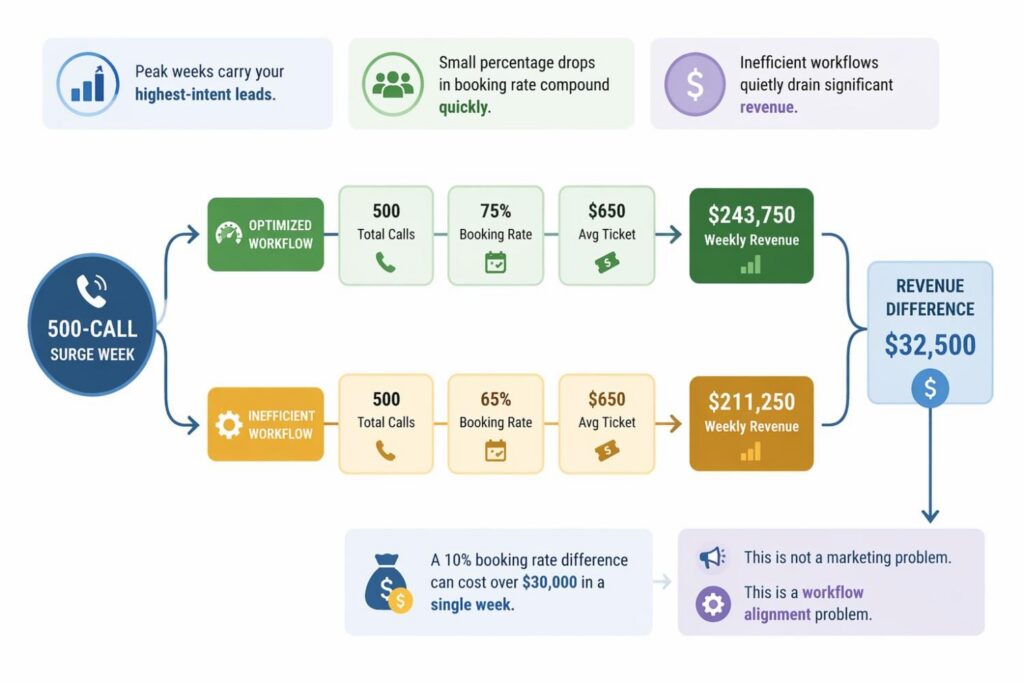
Peak weeks carry your highest-intent leads.
Small percentage drops in booking rate compound quickly.
Revenue Impact Example During a 500-Call Surge Week
Scenario | Total Calls | Booking Rate | Avg Ticket | Weekly Revenue |
Optimized Workflow | 500 | 75% | $650 | $243,750 |
Inefficient Workflow | 500 | 65% | $650 | $211,250 |
Revenue Difference | — | — | — | $32,500 |
A 10% booking rate difference can cost over $30,000 in a single week.
This is not a marketing problem.
This is a workflow alignment problem.
The Titan Pro Framework for Handling High Call Volume in ServiceTitan
High demand validates strong systems.
Here is how to prepare your ServiceTitan configuration for surge weeks.
Baseline Seasonal Call Patterns
Before peak season:
- Track calls per day by month
- Identify surge thresholds
- Review booking rate during prior spikes
- Analyze abandoned call trends
You cannot fix what you do not measure.
Configure Intelligent Call Routing
Route inbound calls by:
- Service type
- Revenue priority
- Technician skill group
- Membership status
- Geographic zone
Routing reduces transfers and speeds up booking.
Implement Priority Handling Rules
Emergency AC outages should not wait behind maintenance calls.
High-value opportunities should route differently than general inquiries.
Prioritization increases revenue capture during peak windows.
Activate After-Hours Revenue Capture
Many contractors lose revenue after 5 p.m.
Activate:
- Missed-call text automation
- Online booking integration
- Next-day callback workflows
- Defined callback time guarantees
After-hours optimization often produces the highest ROI improvements.
Align Dispatch With Real Capacity
Do not overpromise booking windows.
Ensure:
- Skill-based dispatch alignment
- Accurate job duration estimates
- Realistic scheduling buffers
Capacity integrity protects customer experience.
Standardize CSR Scripts and Coaching
Monitor:
- Booking rate per CSR
- Average call duration
- Objection handling patterns
- Membership upsell attempts
Use call recordings for weekly coaching sessions.
Consistency improves booking performance during surge weeks.
Build Owner-Level KPI Dashboards
Every owner should see real-time visibility into:
- Speed to answer
- Abandoned call rate
- Booking rate
- Revenue per booked call
- Technician utilization
- After-hours capture rate
Visibility allows immediate correction.
Common Mistakes Contractors Make During Peak Demand
Many contractors believe being fully booked equals being optimized. Common mistakes include:
Ignoring abandoned call metrics
Every abandoned call during peak season is likely a high-intent customer choosing your competitor.
Failing to update pricebooks monthly
Outdated pricing erodes margins or slows down CSRs when confidence matters most.
Not forecasting seasonal surge volume
If you do not plan for predictable spikes, your workflow will collapse under avoidable pressure.
Overbooking dispatch boards
Cramming the schedule creates delays, callbacks, and customer frustration that damages retention.
No missed-call automation
Without instant response systems, revenue disappears after business hours or during call overflow.
No structured callback process
Unassigned callbacks lead to inconsistent follow-ups and lost emergency jobs.
Peak demand should maximize profitability.
Why Workflow Optimization Is a Revenue Strategy
High call volume is not a customer service inconvenience.
It is a stress test.
When ServiceTitan workflows are optimized:
- Booking rates increase
- Same-day revenue improves
- Dispatch stabilizes
- CSR burnout decreases
- Customer retention improves
Titan Pro Technologies helps home service businesses configure ServiceTitan to perform under pressure — not just during average weeks.
We focus on:
- Workflow alignment
- Pricebook optimization
- Dispatch efficiency
- CSR training
- Real-time KPI visibility
The result is measurable growth.
Conclusion: Fix Workflow Gaps Before the Next Surge
Heatwaves will happen.
Storms will come.
Call spikes are guaranteed.
The only variable is whether your ServiceTitan system converts demand into revenue — or exposes inefficiencies.
If your phones ring nonstop but booking rate stays flat, your workflows need attention.
Request a Free ServiceTitan Assessment to uncover missed revenue, dispatch inefficiencies, and booking workflow gaps before your next surge week.
Peak demand rewards prepared systems.
Frequently Asked Questions
Seasonal demand spikes, storms, system failures, and after-hours emergencies create predictable call surges.
Missed calls often represent high-intent customers. If they reach a competitor first, revenue is lost immediately.
Most contractors should target a 70–80% booking rate on qualified inbound calls, depending on service mix and technician capacity.
With proper call routing, automated booking workflows, after-hours capture systems, dispatch alignment, and KPI monitoring.