Seasonal demand does not create operational chaos. It exposes it.
When a heatwave hits or a hailstorm rolls through your market, your phones light up. But the real pressure does not come from the volume itself. It comes from the weak ServiceTitan optimization & configuration.
If your call routing, booking workflow, and dispatch rules are not built for surge conditions, seasonal call volume in ServiceTitan will create missed revenue, broken schedules, and frustrated customers.
Peak season should increase profit. Instead, for many contractors, it increases stress.
Let’s break down why.
Seasonal Demand Spikes Are Predictable, Your System Should Be Too
Seasonal Call Volume Exposes System Design Weaknesses.
Many owners assume seasonal chaos is a staffing issue.
It usually is not. It is a workflow issue.
When seasonal call volume in ServiceTitan increases, four weak areas fail first:
- Call routing and overflow logic
- Booking scripts and triage enforcement
- Capacity-aware scheduling
- Reporting and follow-up accountability
If these are loosely configured, surge demand creates a chain reaction.
How Chaos Starts Inside A Poorly Configured ServiceTitan Setup

Let’s walk through what actually happens during a peak week.
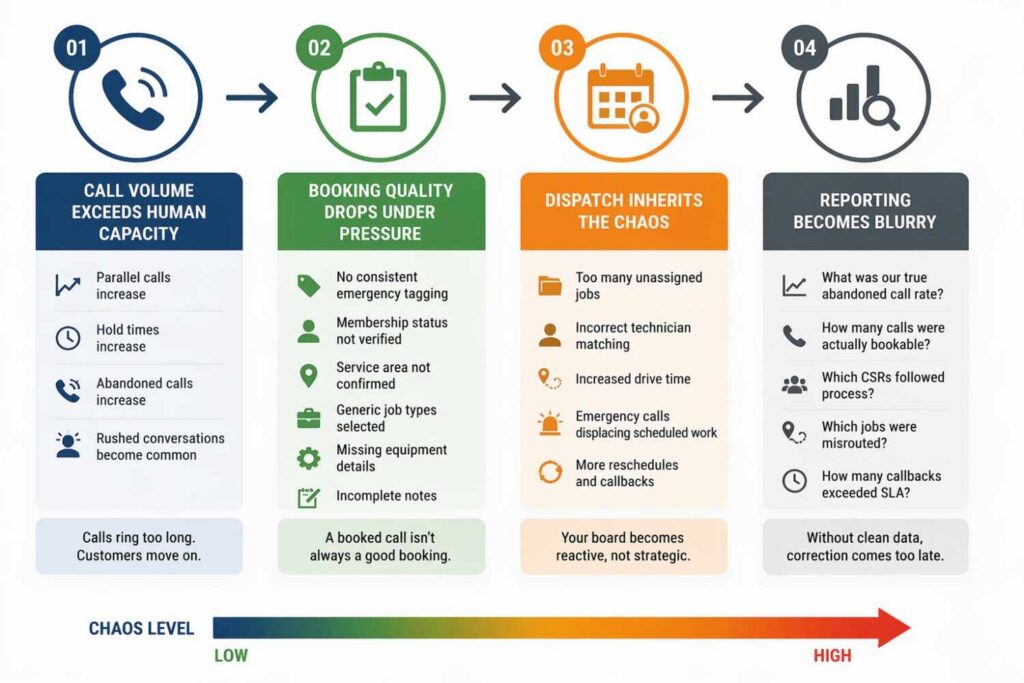
1. Call Volume Exceeds Human Capacity
CSRs can only handle one live call at a time. During a heatwave or post-storm surge:
- Parallel calls increase
- Hold times increase
- Abandoned call rate increases
- Rushed conversations become common
If overflow routing is not configured properly, calls simply ring too long or drop to voicemail. Customers do not wait during emergencies. They call the next contractor.
2. Booking Quality Drops Under Pressure
Even when calls are answered, quality declines. When CSRs feel urgency, they skip structure. That is human nature. Common booking breakdowns include:
- No consistent emergency tagging
- Membership status not verified
- Service area not confirmed
- Generic job types selected
- Missing equipment details
- Incomplete notes
This is where ServiceTitan call booking workflow integrity matters most. A “booked call” is not always a good booking.
3. Dispatch Inherits The Chaos
When booking lacks structure, dispatch pays the price. Symptoms show up fast:
- Too many unassigned jobs
- Incorrect technician matching
- Increased drive time
- Emergency calls displacing scheduled work
- More reschedules and callbacks
Dispatch capacity planning in ServiceTitan must align with booking logic. If it does not, your board becomes reactive instead of strategic.
4. Reporting Becomes Blurry
Peak season is when you need visibility the most. But if reporting is not clean, you cannot answer simple questions:
- What was our true abandoned call rate?
- How many calls were actually bookable?
- Which CSRs followed process?
- Which jobs were misrouted?
- How many callbacks exceeded SLA?
Without clean data, correction comes too late.
What Poorly Configured ServiceTitan Looks Like During Surge Conditions
You may recognize these patterns.
Routing Gaps
- No structured overflow after short ring window
- After-hours calls default to voicemail
- Calls bounce between departments
- IVR menus confuse urgent callers
Booking Gaps
- Required fields not enforced
- Triage rules inconsistent
- Emergency tags applied randomly
- Job types overly broad
Dispatch Gaps
- Large unassigned backlog by midday
- Route optimization underused
- Frequent reschedules
- Unrealistic arrival windows
Follow-Up Gaps
- Missed calls not converted into tasks
- No callback SLA tracking
- Lead attribution incomplete
Seasonal call volume ServiceTitan issues are almost always configuration gaps amplified by urgency.
Why HVAC And Roofing Feel This Pressure First
When nearly nine out of ten households use air conditioning, extreme heat creates simultaneous failure events. That compresses demand into short windows.
When hail damage averages nearly $1 billion annually, roofing contractors experience concentrated inspection requests. In both trades, customers are not casually browsing. They need help immediately.
This compresses your margin for error.
If your ServiceTitan phone system configuration cannot absorb surge volume, customers move on quickly.
The Core Design Flaw: Routing By Department Instead Of Intent
Many ServiceTitan systems are structured around internal roles. That model breaks during surge conditions. A better approach is intent-based routing.
What Is Intent-Based Routing?
Intent-based routing directs calls based on what the caller wants to accomplish:
- Emergency repair
- Routine service
- Installation estimate
- Membership visit
- Reschedule
- Billing question
When routing matches intent:
- Transfers decrease
- Call time shortens
- Booking accuracy improves
- Dispatch receives better data
During peak season, clarity wins.
The Four Configuration Fixes That Prevent Peak-Season Chaos
Strengthen Overflow And After-Hours Capture
Peak demand requires a shock absorber. Effective configuration includes:
- Overflow routing after 15–20 seconds
- Structured after-hours capture
- Emergency escalation logic
- Automated follow-up tasks
Voicemail alone is not a workflow. It is a risk.
Enforce Triage Within The Booking Script
Triage must consistently capture:
- Urgency and safety risk
- Membership status
- Service area validation
- Equipment type and symptoms
- Preferred timing
- Access details
Without enforced prompts, surge volume creates inconsistent data. Inconsistent data creates dispatch instability.
Align Booking With Capacity
Capacity-blind booking causes overpromising. Peak-ready systems:
- Front-load non-urgent work earlier in the day
- Preserve afternoon buffer for emergencies
- Book strategically rather than reactively
Capacity awareness protects revenue and reputation.
Create Clean Escalation Paths
Escalation should:
- Route directly to the right human queue
- Include a short call summary
- Prevent customers from repeating themselves
During high call volume, smooth handoff preserves trust.
The Peak Season KPI Dashboard You Should Monitor
You do not need dozens of metrics. You need visibility into these:
- Abandoned call rate
- Speed to answer
- Booking rate
- Bookable lead set rate
- Escalation rate
- Callback SLA compliance
- Midday unassigned backlog
- Reschedule rate
- Route efficiency
When seasonal demand spikes, review these daily. What gets measured gets stabilized.
A 2026-Ready Model For Handling Seasonal Call Volume In ServiceTitan

The best companies do not overhaul everything at once. They phase improvements.
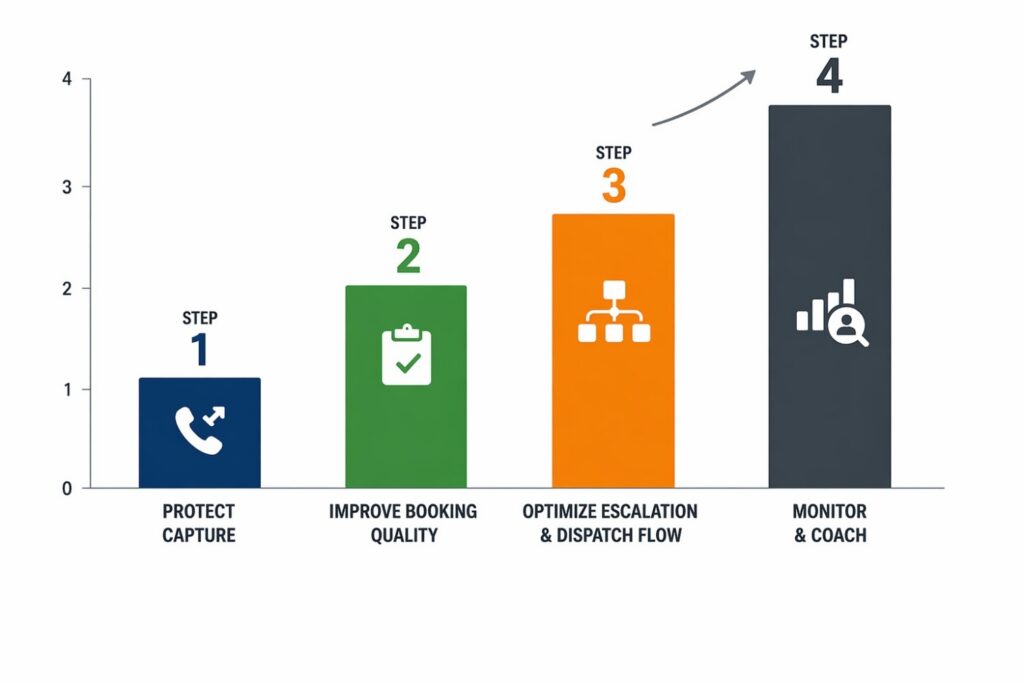
Phase One: Protect Capture
Start with:
- Overflow routing
- After-hours structure
- Missed call task automation
This prevents silent revenue leakage.
Phase Two: Improve Booking Quality
Audit:
- Required fields
- Emergency tagging consistency
- Service area rules
- Call recordings for QA
Clean inputs stabilize dispatch.
Phase Three: Optimize Escalation And Dispatch Flow
Refine:
- Escalation routing
- Capacity buffers
- Dispatch board logic
- Technician skill matching
Precision reduces stress.
Phase Four: Monitor And Coach
Use CSR scorecards and dispatch KPIs to:
- Identify weak points
- Coach consistently
- Adjust scripts and tags
- Improve weekly
Peak season becomes a system event, not a panic event.

Real-World Example: HVAC Heatwave
During a 100-degree week:
- “No AC” calls spike sharply
- Emergency urgency increases
- Customers expect same-day service
If emergency tagging is inconsistent, dispatch cannot prioritize correctly. If overflow is weak, abandoned calls rise. If capacity is overbooked, arrival windows break. With proper configuration:
- Emergencies are flagged consistently
- Same-day capacity is protected
- Missed calls become tracked callbacks
- Reporting reveals real-time bottlenecks
Chaos decreases even though volume increases.
Why Titan Pro Technologies Fixes The Root Cause
Titan Pro Technologies is a ServiceTitan Certified Provider based in Blue Bell, Pennsylvania. We focus on:
- ServiceTitan phone system configuration
- Workflow alignment
- Dispatch optimization
- KPI dashboard design
- CSR and dispatcher training
- Ongoing optimization
We align routing, booking, dispatch, and reporting into one cohesive system that holds steady under pressure. Seasonal spikes do not disappear. But chaos does.
Let’s Wrap!
Seasonal call volume will always increase in HVAC and roofing. The data proves it. With 88% of households using air conditioning and storm damage averaging nearly $1 billion annually, demand spikes are built into your industry. The difference between chaos and control is configuration.
If your ServiceTitan system is not designed for overflow, triage enforcement, capacity-aware booking, and KPI visibility, peak season will continue to feel overwhelming.
Request a Free ServiceTitan Assessment from Titan Pro Technologies.
We will evaluate your call flow, booking quality, dispatch alignment, and reporting clarity before your next surge hits. Peak season should drive growth.
Frequently Asked Questions
Because higher volume reduces human margin for error. Small routing and booking gaps become major workflow failures under pressure.
Implement overflow routing, enforce required booking fields, and automate callback tasks tied to a clear SLA.
Fix workflow first. A well-configured system often improves performance before increasing headcount.
If bookings are accurate but customers experience late arrivals and frequent reschedules, dispatch capacity rules need refinement.
Abandoned call rate, booking rate, escalation rate, callback SLA compliance, and unassigned backlog are critical indicators.